Wednesday, February 29, 2012

Bloom to Bar?

(Day 14)

Bloom iron has a physical texture and integral chemistry quite different from modern industrially produced steels.

Both of these are a result of the creation process, the reduction of raw iron oxide ore inside the direct process bloomery furnace. (see Day 11)
As the individual particles of metallic iron sinter together at the bottom of the furnace, they are accumulating inside a pool of liquid glassy slag. If you stopped this process early in the sequence, then cut open the mass, what you would find is something that looks like this:
'Proto-Bloom' - Early Iron 1, 2004
Preparation, Description & Images by Elizabeth Henricks

The iron starts to collect together with the matrix of the slag, almost like soap bubbles.
As more and more iron accumulates, the developing bloom will become denser and denser. At first the bloom is very lacy, almost as much slag as iron. This is especially the situation with furnaces utilizing low volume, low pressure air blasts.
The iron of course is considerably heavier than the slag. So as more and more is reduced and it clumps together, it presses out more and more of the slag. The ideal is to create a dense 'puck' of metal. The classic shape is 'plano-convex' - a slightly oval half sphere with a flat top :


Vinland 2- October 2009 (5.6 KG)
Side view, showing rough placement in the furnace.

Now, the ideal bloom will be very dense, but some of the slag always remains trapped inside the metallic mass:

Vinland 1 - May 2009 (4.9 KG)
Sliced in half, surface polished (upside down in photo)

The raw bloom thus will have both voids and inclusions of slag. The better the skill of the smelt master, the denser / more solid the bloom will be. Remember that historically, the objective of whole smelting process is to produce working bars of solid iron metal (!).

Replica Viking Age 'Currency Bar'
Forged down from bloom (November 2005 smelt)

This process, 'Bloom to Bar' represents an entirely different stage of the iron production sequence.

Individual raw blooms will vary considerably how lacy or solid they may be. The actual carbon alloy content is likely to vary, even across the same bloom (more on that later).

The process of forging a bloom down to a working bar involves compacting, cutting, folding and welding. It is to gain more direct experience with this aspect of the overall process that this OAC Grant is supporting.


Readers may be noticing a bit of disorganization between the individual postings (hopefully not too much *within* individual postings!). This is because my attempt to provide a daily commentary does mean I am jumping around in terms of actual subjects (rather than a concise continuing narrative). The topic of the daily posts most often does not reflect the physical work being undertaken on that same day.

Why Bloom Iron ?- five

(Day 17)

The second distinctive characteristic of bloomery iron is variation in carbon content.

(This is going to be a bit technical for the non-metalsmiths.)

Carbon has a major effect on iron when it is added (alloyed) to the metal. Even small amounts of carbon drastically effect the relative resistance to deforming (effectively the hardness). Some modern metals with their approximate carbon contents:
'Electric Iron' ( a low carbon Bessemer steel, used for transformer cores) - about 0.05 % Carbon
Mild steel (what most everything is made of, from cars to I beams) - about 0.2 % Carbon
Spring steel (old leaf and coil springs in autos, heavy cutting tools) - about 0.5 % Carbon
Tool steel (small, sharp cutting edges) - about 1.0 % Carbon
Cast Iron (cookware, stoves) - about 2.0 % Carbon

Because iron alloyed with carbon resists forming - it will get increasingly more difficult to actually forge (hot hammer) shapes. In the pre-Industrial Age world, the ideal iron for the blacksmith had as *little* carbon in it as possible.
You can see that this works in direct opposition to the requirements of the blade maker. For a durable cutting edge, you would want some amount of carbon present. Hardness equals edge holding ability. Also the complex series of heat treating methods apply to Carbon alloys. (A topic for *much* later!)


Remember our idealized direct process bloomery furnace:

Carbon is *not* present in the starting iron oxide ore.
Carbon may be absorbed by the reduced metallic iron in two ways:
First, directly to the surface of the individual particles as they fall down the body of the furnace. This is most commonly found with very small particle size ore, or with a furnace that is allowed to run too hot.

The second place carbon can come from is into the surface of the bloom, as it sits inside the liquid slag in the bowl at the bottom of the furnace. This is a slower process, so the carbon tends to diffuse from the outer layers towards the centre.
With larger blooms, the effective ratio of surface area to internal volume is lower. So this carbon variation effect tends to be more obvious with smaller blooms.
Also, the quality of the individual bloom comes into play. The folding and re-welding process will tend to 'average out' variations in carbon content ('carbon migration'). There can also be carbon absorbed from the fuel during repeated welding heats.

Ok - enough theory - what is the practical effect:

Bloom Buckle - Winter 2011
Forged from a small bloom fragment

The variation in colours seen over the surface of 'Bloom Buckle' is a direct result of variations in carbon content within the metal. As a small fragment, the original metal was more drastically effected by carbon diffusion across its surface (high area to volume ratio).
The finished buckle was water hardened, then etched with a Ferric Chloride solution to highlight the differences in carbon content. (This is a variation on the process used for my layered steel knives.)

This is another effect which I intend on exploring (if time permits) within the framework of the OAC Grant.


Note to Readers :
The Arts is well known for its (often inpennetrable ) jargon. You may have noticed I don't tent to use this 'Language of the Artist'. What you will find here is a tendency to technical jargon - itself often poorly understood (and frequently *improperly* used). I would refer you to my commentary piece 'Defining the Artist Blacksmith'.

Tuesday, February 28, 2012

Why Bloom Iron ?- three

(Day 13)

As is becoming obvious to those reading past postings, my main attraction to bloomery iron is a technical / cultural / artistic one.


My close friend (initially teacher and eventually workshop fellow) Lee Sauder was initially inspired to attempt to smelt his own iron because of a kind of Virginia Hillboy Ethic : " You should kill what you eat." As a working artisan blacksmith, he considered it important to the understanding of iron as a material to have experienced the creation of iron bar - from dirt. Lee had originally looked at 'traditional' African furnaces. There was some video that had been shot in the 1970's showing some old fellows undertaking one last iron smelt, from what they could remember seeing as young boys. (Compare this with Europe, where there was no living tradition at all.)
Right - Bloom Iron Vase - Sauder
Of course, the bug bit him big time. When I first met Lee (in 2002) he and his working partner Skip Williams had roughly 50 smelts undertaken (about where I am now). I consider Lee and Skip to be by far the most experienced iron smelting team in North America. Along with Mike McCarthy (and myself) they are at the core of the new 'Early Iron' movement.

My own interest in iron smelting started from a historical standpoint. The first iron ever produced in North America was made by the Norse in Vinland, circa 1000 AD. The site at L'Anse aux Meadows Newfoundland contains the remains of what was most likely a single use furnace. The estimated yield has been (very approximately!) calculated at about a 3 kg bloom.

Because of my work on the Norse Encampment living history program for Parks Canada, I was part of a small research working team in Summer of 2001, considering how best to represent this event to the visiting public. My very first attempt at smelting iron was made at that workshop. (And believe me, if there ever was a case of 'everything you know is wrong' - that certainly was it!)
Right - First Iron Smelt - 2001

From a purely technical standpoint, my interest was sparked by the historical traditions from early Europe. As with Lee and Skip, it was clear that I had to learn how to actually functionally *make* iron first. The clay 'short shaft' furnace that would become the standard model here in Wareham was based on archaeological evidence. However, modern equipment and 20th Century perceptions of science based methods would inform the techniques that were developed.
At this point, if I stick to known raw materials, and follow the established equipment set up and proven method, I can reliably produce a good quality iron bloom every time. An important direction to this continuing experimental work is to remove these modern elements, one by one. The exact methods used in ancient Norse iron smelting represent a completely shattered and unknown working tradition. Even the archaeology can only at best give the most general clues into the actual working methods used 1000 years ago.
Bloomery Iron represents a material functionally different than our modern metals. How you forge individual shapes leading into a completed object can be quite different than those you would use if utilizing modern industrial mild steel.

My interest in Iron as a cultural material remains tightly bound with a lifetime of exploring the history of Scandinavia during its 'Viking Age' - 800 to 1000 AD. The Norse were well known for their skill as metal workers. Their method of welding layered and twisted iron alloys together to create 'pattern welded' (or 'twisted composite core') sword blades created some of the most complex forged objects ever created. Although initially undertaken for purely functional reasons, they would raise the technology to high art.

Sword of Heroes - 2000 Detail
Two 9 layer twisted core rods with spring steel edges.

The raw difficulty of producing iron in the first place, coupled with the limits imposed by small anvils and use of simple charcoal forges combined to lift iron to a material suitable for high status objects. To the Norse, elaborately forged and elegantly designed iron objects were the equipment of kings and queens.
There is a drastic change in our modern frame of reference, where iron (mild steel) is so cheap that it is both plentiful and generally only considered a functional material. As an artisan blacksmith, I strive to change this popular perception of iron as material. The value of aggressively hand forged objects lies in the skill of the hands which had created it, not in the cost of the raw material.

Cauldron Hanger - Sutton Hoo, c 625 AD
(replica, the British Museum)

The Norse possessed a series of distinctive artistic styles, changing over time. My own personal design style, which I call 'Rivendale', has been deeply informed by the artifacts of the Viking Age.

The purpose of my OAC Crafts Project Grant is to allow me working time to blend these aspects of technical tradition, cultural framework - and artistic vision.

Monday, February 27, 2012

Haliburton Sculpture Forest Submission

(Day 12)

Currently there is an open call underway for a new work for the Haliburton Sculpture Forest :
" The Board of the Haliburton Sculpture Forest announces a competition for a new
sculpture for the Haliburton Sculpture Forest in Glebe Park near the village of
Haliburton, Ontario.

The Haliburton Sculpture Forest is looking for a work of artistic/design excellence
and durability that suits the natural attributes of the Haliburton Sculpture Forest and
addresses the theme “Avian Fauna” (birds of the region)
...
Proposed sculptures can be representative of specific birds of the Highlands or can
be a work that brings the image of birds to the eye of the viewer.

The sculpture will be located in the Sculpture Forest along walking/cross country
skiing trails adjacent to the campus of Fleming College and the Haliburton School
of The Arts. The trails are used by thousands of walkers and skiers throughout the
year. The Sculpture Forest was started in 2001 and currently has 25 sculptures by
Canadian artists."
Although I have known about this competition for about six weeks, I really had a bit of trouble coming up with a suitable concept for a new work. In connection with my Crafts Project, I did want to use bloom iron as a major component. This is what I came up with:

Title: 'If You Build It - they will come'
Form: bird bath / feeder


Concepts:

Almost any sculpture providing the required durability and longevity for the Haliburton Sculpture Forest needs to be rigid in its construction. How to add movement to such an enduring form? My solution is to attract natural life itself into the sculptural framework. 'If you build it' thus entices the birds themselves to become an ever changing dynamic component of the work.

Gold Finch perched on my 'Glass Disk Hanger'

The central bowl is a irregular shape created from bloomery iron. The Near North region is covered with deposits of naturally occurring bog iron ore deposits. In the Settlement Period (1800's) these deposits were sources to the first iron industries in Ontario, the Marmarra Iron Works a prime example. Thus the primary material of sculpture is related directly to the Region.

Bloomery iron has a distinctive texture and visual appearance quite unlike our modern metals. I am the only artist in Ontario who creates and works with bloomery iron. Bloom iron, due to its low carbon content, will weather slower than modern mild steel. As it does oxidize, the slag occlusions this metal contains will cause it to weather in unusual patterns.
The shallow bowl becomes a natural bird bath, filled passively by rain. It also could be used as a feeder in winter months, attracting wild life.


Bowl forged from Bloom Iron - 2011

The bowl at the heart of the sculpture is held up in a loose basket made of intertwined organic elements. Forged of stainless steel, these pieces will have a light grey colour, contrasting sharply with the dull black of the lower bowl. The uprights are stylized interpretations of two common Ontario road side plants. To one side will be a bundle of gracefully tapering rushes. To the other are a spray of my distinctive 'feather' forms, which are inspired by the reed Phragmites. Balanced against each other, the native plant and the invasive species. Who can say which is more 'natural'?

'Fire at Heart', 2oo8
Use of the 'Feather' element

The base frame of the sculpture will be covered with a loose spray of natural beach stones - gathered from the Region. First are oval, wave polished stones from the Lake Huron shore (Goderich area). The second are fragments of pock marked limestone from Manitoulin Island. If possible, some pieces of the dramatically folded granite from East Georgian Bay would be included.


Manitoulin Limestone - as sculpture base ('Crinoids' - 2012)

Size / Scale

In keeping with the four seasons use of the Sculpture Forest, 'If you build it' is scaled to retain a physical presence even with three feet of snow ground cover. The sculpture has an overall height of about seven feet. The area the sculpture occupies is an irregular oval about 3 1/2 by 3 feet.

The central bowl is an irregular oval shape overall, roughly 18 to 24 inches in diameter, about 6 inches deep. The top edge of this bowl will sit at roughly four feet off the ground.
As well as clearing the snow cover, this placement allows the rough textured lower / outer surface of the bowl to be easily viewed as the observer approaches - through the bulk of the seasons.
The inner surface of the bowl will be ground smooth. Initially this will make a bright surface, which will oxidize differently than the outer surface as time goes by. This difference becomes a visual discovery for the viewer as they approach closely.

The individual curved organic elements vary in height. The top of the lowest will sit at roughly five feet from ground level, extending to closer to seven feet for the tallest. The graceful curves sweep the terminal points inwards, providing a measure of safety. The 'feather' elements will be about 2 - 3 inches wide. The 'rushes' will be about 1 1/2 inches diameter at their widest.

What is above is only an excerpt from the larger detailed description prepared for the submission. If any reading are interested, the total time taken for the layout drawing, researching the costs and preparing the supporting documentation was roughly 10 hours. (If you're wondering where the time goes...)

Image 'Bird on Disk' by Karen Peterson

Sunday, February 26, 2012

How to make Bloomery Iron

(day 11)

How *do* you make bloomery iron?
Without getting into fine detail, this is a fast description of how it works:


"Briefly, the furnace is a cylinder of clay filled with charcoal, with high combustion temperatures supported by the injection of air into the base of the furnace. Once fully ignited, ore is added in small batches, while keeping the shaft filled with charcoal. Burning charcoal creates superheated carbon monoxide (CO) gas, which reacts with the iron oxide (Fe2O3) contained in the ore. In effect, the more reactive CO rips off the oxygen, leaving metallic iron behind. This iron is heavier, so it falls to the base of the furnace. A liquid glassy slag also forms, composed of melted furnace wall, silica from the ore, and charcoal ash. Falling to the colder base of the furnace, it congeals, forming a bowl shape. The descending iron particles collect inside the liquid pool of slag within this bowl into the bloom mass. Excess slag may have to be tapped off to prevent blocking the air flow at the tuyere. The bloom is finally extracted while hot, either through the top or bottom side of the furnace, then hammered to consolidate it."

" There is a relationship between furnace size, position of the air system, air volume required, the nature and size of the ore particles, the size of the charcoal fuel, and the best sequence of adding both charcoal and ore. Changing any one of these variables will alter the nature of the bloom produced. Using the wrong combination may result in there being no effective production of iron at all. "

The quoted sections are from my just published article 'If You Don't Get Any IRON..." in the journal 'EXARC'
Typical Experimental Iron Smelt set up.
Industrial blower, air gate and metering system, hose to T shaped viewing port in turn attached to tuyere.
Clay 'Short Shaft' furnace, with charcoal fuel stacked ready to consume.
Vinland 1 - May 2009 (Go on for details)


Readers interested in far more detail on bloomery iron making are referred to the Wareham Forge Experimental Iron Smelting web site.

Of special interest will be a couple of fast working guides to building and running an iron smelting furance:

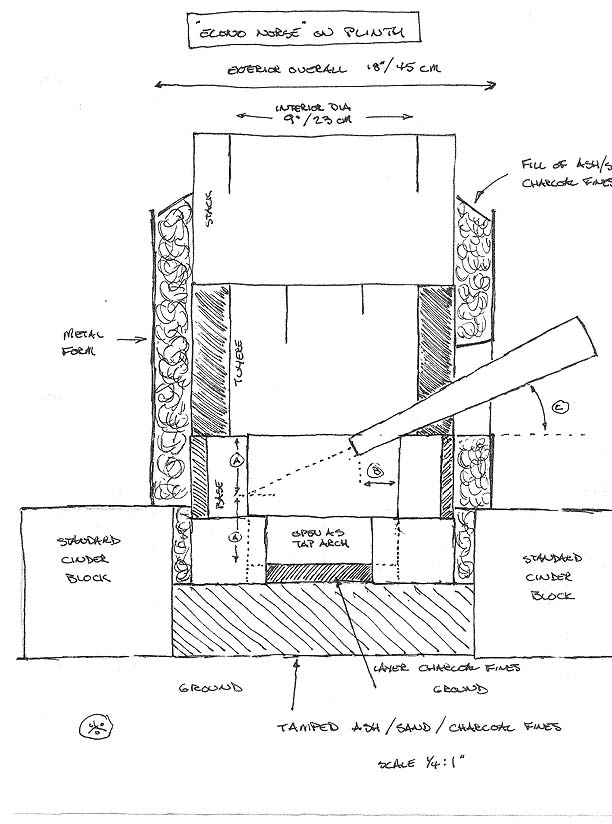
the Econo Norse Smelter
Developed by the DARC smelt team - using standard fire brick packed with sand
Go on Econo Norse Handout.

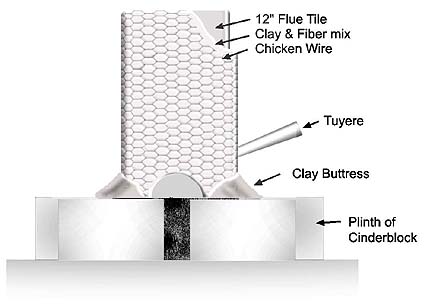
the Flue Tyle Smelter
Developed by Sauder and Williams - using a ceramic chimney liner
Go on Flue Tyle Handout.


As work with the individual blooms progresses, there will be references back to the individual smelt events which produced each bloom.


Readers may notice a couple of things: First, the grand plan of a blog post every day obviously got overtaken by the flow of other work. Second, days worked on the project bear little resemblance to any kind of 'normal' (M-F) work week. Such is the real life of the artisan!

Thursday, February 23, 2012

'Medieval Iron' - if you missed the lecture?

(day 6)

I've taken the slides from my 'Medieval Iron' lecture from yesterday and formatted them up into a series you can see on the web.

This will not give you meat of the 1 1/2 hour lecture!

I may be of interest to some :

Go on here to 'Medieval Iron'

Wednesday, February 22, 2012

Why Bloom Iron ?- two

(day 5)

This will only be a fast post (and a bit out of sequence) as I'm off to Peterborough in a couple of hours for a public lecture :
Society for Creative Anachronism, Trent University, Peterborough Ontario
Lady Eaton College / Building 7, rm 208
7:30 PM

'Medieval Iron - an Overview'
A fast look over Iron as a material, iron work as a process, and iron objects of the Middle Ages. A focus will be to take a look at the kinds of objects of special interest and utility to the re-enactor. There will be a simple overview of blacksmithing equipment from the period - and what you would need to get started *historic* forging. Illustrated with images and replicas.
****

The objective of my iron smelting work has been to produce a very low carbon metal. This most definitely was the primary objective in 'ancient' times. A low carbon iron metal is easiest to forge, so is the desired material for general blacksmithing work.

'Redemption' Bloom - November 2006

Modern Artist Blacksmiths usually use the term 'traditional' when they are talking about equipment, methods, and by extension materials, from the 'Industrial Age' - being roughly 1800 - 1900. This brackets the last of the large scale bloomery furnaces and the invention and growth of the Bessemer furnace, so the last decades of commercial wrought iron metal. (Generally commercial wrought iron was out of production and use in North America by around 1900. Actual wrought iron metal has not been produced in industrial quantities any place in the world since roughly 1975. See : Wrought Iron Work : What it IS - What it MEANS.

In the last post, I referred to 'historical' as the period which brackets the implementation of water powered machinery (in Europe) - being roughly 1000 - 1800. This is a great generalization, because there are a huge number of changes in the methods used to produce iron within those centuries. There is a gradual shift from small scale direct bloomeries to larger scale more 'industrial furnaces' over that period. High carbon cast iron will begin to be produced into the 1500 - 1600's, plus the introduction of coke (from coal) as fuel.

Almost by default, I'm then referring to the time from the first discovery of iron smelting up to the end of the Viking Age becomes 'ancient' - roughly 2500 BC - 1000 AD. As this is a massive time frame, there are certainly a number changes in iron making processes. All however are some variation on the small scale direct reduction bloomery furnace.

It has been with this series of ancient furnace technologies that I have been directly experimenting and implementing.
'Celtic Iron Age' : A re-enactor using a simple drum type bellows with a ground pit blacksmithing forge

February 15 - May 15, 2012 : Supported by a Crafts Projects - Creation and Development Grant

COPYRIGHT NOTICE - All posted text and images @ Darrell Markewitz.
No duplication, in whole or in part, is permitted without the author's expressed written permission.
For a detailed copyright statement : go HERE